

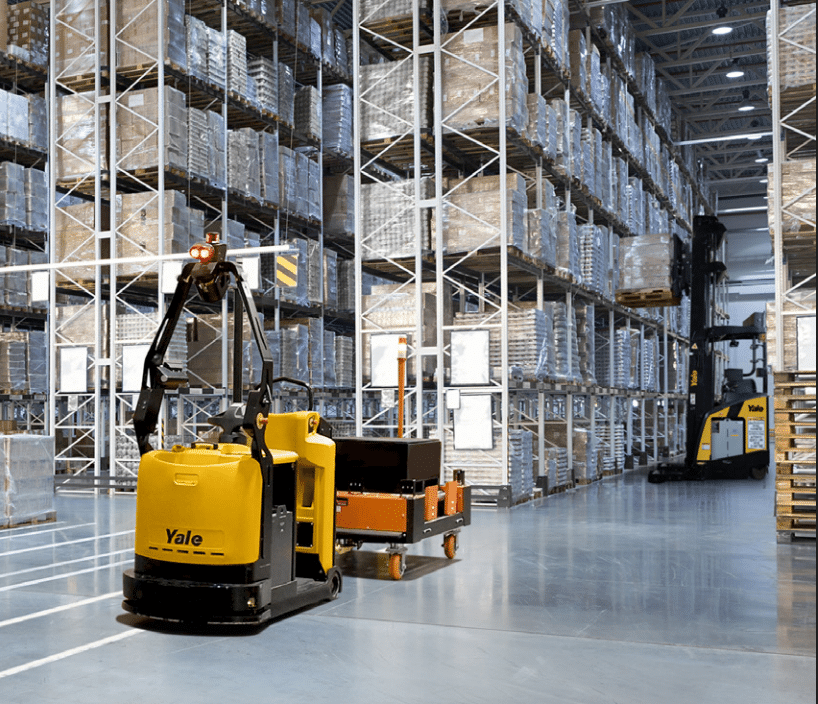
Bringing Yale’s Automated Systems into Your Material Handling Strategy
Summary: Explore how Yale robotic automation strengthens transport, storage, and dock workflows to elevate your entire warehouse strategy.
10/28/2025
Warehouse automation works best when it supports the entire operation of any unique facility. Yale robotic automation is designed around real warehouse applications, helping facilities improve flow, safety, and consistency across automated operations.
At Voss Equipment, our sales team has been participating in advanced training on Yale’s automation technologies so we can better guide customers through implementation. The focus isn’t simply robotic forklifts. It’s building a smarter, more connected material handling strategy.
Application-Driven Automation
Yale’s approach centers on how materials actually move through a facility. Rather than forcing new workflows, warehouse robotics integrate into existing ones.
Common robotic automation applications include:
- Repetitive horizontal transport between zones
- Dock-to-stock pallet movement
- Line-side delivery for production support
- Cross-docking and staging transfers
- Support for automated warehouse storage strategies
By targeting predictable travel routes, robotic lift trucks reduce variability while maintaining consistent throughput.
Transport and Dock Efficiency
In many facilities, especially across Harvey, IL, and the greater Chicagoland region, the most time-consuming work involves repetitive travel. Moving pallets from receiving to storage or from staging to shipping consumes labor hours that could be reallocated.
Robotic forklifts are particularly effective in these environments because they are:
- Built on proven industrial truck platforms
- Equipped with advanced navigation systems
- Designed to operate safely alongside manual equipment
The result is automated operations that increase efficiency without requiring a complete facility redesign.
Supporting Storage Strategy
Warehouse automation also plays a key role in storage optimization. In higher-density layouts or fast-moving inventory environments, robotic lift trucks can support accurate pallet placement and retrieval.
This supports:
- Organized inventory flow
- Improved consistency in putaway
- Reduced travel congestion
- Enhanced safety compliance
Automation becomes a tool for strengthening overall warehouse structure, not just speeding up movement.
Scalable and Data-Driven
One of the advantages of modern robotic automation is scalability. Facilities can begin with a single workflow, such as dock transport, and expand automation as operational needs evolve.
Connected fleet systems provide visibility into details such as how equipment is used, the most efficient routing options, and bottlenecks that easily occur. When you use a data-driven approach, operations and management can make informed decisions designed to improve long-term performance. It looks at the bigger picture.
A Whole-Warehouse Strategy
Successful warehouse automation requires evaluation of traffic patterns, labor allocation, and growth planning. Yale’s robotic automation solutions are engineered to fit into that larger operational picture.
At Voss Equipment, we work with customers to assess how robotic forklifts, warehouse robotics, and automated warehouse storage solutions can align with their broader material handling goals. Through ongoing training and application expertise, we help facilities implement automation strategies that are practical, scalable, and performance-focused.